Ukulele Lessons
Small, friendly and endlessly fun — the uke is a brilliant first instrument and a gorgeous accompaniment for singers. Lessons for kids, beginners and singer-songwriters, in London or online worldwide.
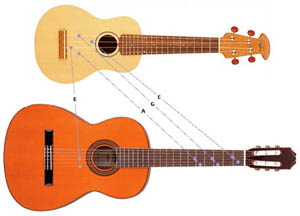
Also known as the uke — or ukelele, as it is just as often spelled — the ukulele was born in 19th-century Hawaii, found fame in the USA a century later, and spread around the world from there. It belongs to the lute family, and its four strings are tuned like the guitar’s 3rd (G), 2nd (C instead of B) and 1st (E) strings, plus a top A.
Think of it as the low four strings of an eight-string guitar — G, C, E, A — but pitched higher. Smaller than a guitar and easy on the hands, it’s a favourite with kids and, as a superb strumming and vocal-accompaniment instrument, with singer-songwriters of every age.
Four strings,
endless fun.
Chords & strumming
The joyful heart of the uke — clean chords and rhythms that swing.
Fingering technique
Clean, comfortable fretting so every note rings true.
Picking & fingerstyle
Play with the fingers for a harp-like, flowing sound.
Single-string melodies
Pick out tunes note by note, not just chords.
Songs
Learn the tracks you love — the fastest way to keep going.
Reading TAB
Read TAB as standard, plus notation if you’d like it.
For kids & beginners
We start with some basic chords and strumming patterns, then move on to melodies as you progress. For children, the soprano and concert sizes are the ones I’d suggest — comfortable to hold and easy to play.
For singers
Here you’ll also learn to play with your fingers, so the sound turns more harp- or lute-like and flows like a waterfall under your voice. Throughout, we keep a close eye on the pulse of the music — that’s what lets you sing and play at the same time without either one falling apart.
Sizes, tunings & buying tips
The uke’s tone and volume change with size — from the small, bright soprano up through concert and tenor to the rounder, fuller baritone. Most ukes come in standard re-entrant High-G tuning (great for accompaniment), while Low-G tuning suits guitarists switching over, as it opens up more scalar and melodic playing. The baritone is the exception, tuned like a guitar’s top 4 strings — D, G, B, E. When buying, choose one where you can see the wood: coloured varnish ruins the sound. Fun variants exist too, from the pocket uke (sopranissimo) to the U-bass and the guitalele.
Where lessons happen
In-studio in London SE16 — Rotherhithe, Canada Water and Surrey Quays — at your place anywhere within TfL Zone 3, including Bermondsey and Borough (SE1), Walworth (SE17), Deptford (SE8), New Cross and Peckham (SE14, SE15), Lewisham (SE13) and Canary Wharf (E14), or live online worldwide over Zoom/similar. When the weather’s kind, studio lessons can even move out to a private front-garden area. Get in touch and we’ll pick what fits you best. I teach music lessons right across South East London — see the areas I cover →.
Simple, honest rates.
| Lesson | Format | Price |
|---|---|---|
| 30 min · one-to-one | Studio · online | £30 |
| 50 min · one-to-one | Studio · online or 4 lessons for £150 | £40 |
| 50 min · group course | Per person 12 sessions upfront | £14 |
At-your-place lessons are £40 plus a small travel surcharge. See the full fees, blocks and referral cashbacks →
Ready to strum along?
Tell me who’s playing — you or a young beginner — and what you’d love to play. I’ll get your first ukulele lesson booked.